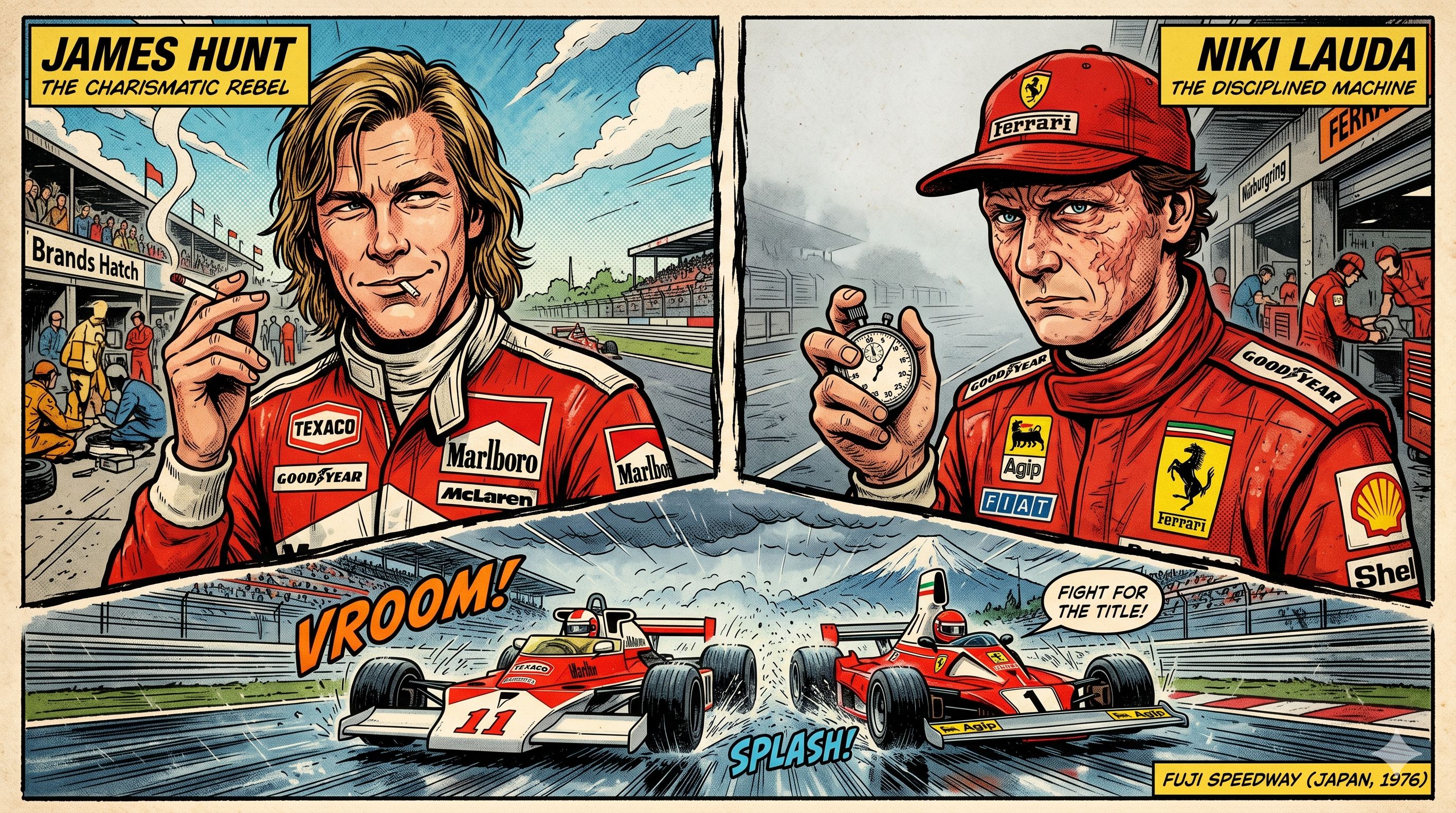
The 1976 championship finished with James Hunt on 69 points and Niki Lauda on 68. Sixteen races, a single point, one of the most-told F1 stories ever — and the numbers behind it are wilder than the film made them look.
How Lauda was supposed to win it
Lauda came into 1976 as defending champion and won Brazil and South Africa from the front row. By round nine — the British GP — he’d taken five wins and two seconds. He had 58 points. Hunt had 26.
A 32-point gap in 1976 scoring (9 for a win, only your best results counted) was almost a season’s worth. The championship looked over.
The Nürburgring
Round 10, the German Grand Prix, ran on the 22.8-km Nordschleife in driving rain. Lauda had argued — almost alone among the drivers — for the race to be cancelled on safety grounds; he was outvoted. He lined up second on the grid.
On the second lap his Ferrari snapped right at the high-speed Bergwerk section, hit the bank, and bounced back into the path of Brett Lunger and Guy Edwards . The car caught fire. Lauda — trapped in the cockpit, helmet partly knocked off — inhaled toxic fumes for the nearly two minutes it took to pull him out.
He was given last rites in hospital. He raced again 42 days later.
Hunt’s summer of luck and ruling
While Lauda was in intensive care, Hunt won the British Grand Prix — and then had it taken away from him in a courtroom. Hunt had been involved in a first-lap collision, used a spare car for the restart (which the regulations didn’t allow), won the race, and was disqualified months later when Ferrari appealed. The nine points he’d scored at Brands Hatch went to Lauda; the championship swing was effectively eighteen.
Hunt won the German GP from the chaos of Lauda’s crash, then Holland, then Canada, then the US — four wins in five races after Lauda returned from the burns and finished fourth at Monza through full-face bandages. With one race left, the gap was three points.
Mt Fuji
The Japanese Grand Prix was the first F1 race held in Japan. The weather at Mt Fuji on race day was a monsoon — standing water on the straights, almost zero visibility behind the spray. The drivers held a pre-race meeting and very nearly refused to start. Eventually they did.
Lauda completed two laps, came in, and retired the car. He told his team the conditions weren’t worth losing his life for. Three other drivers (Carlos Pace, Emerson Fittipaldi , Larry Perkins) followed him off the track. Hunt led for most of the race in his McLaren, then dropped to fifth after a punctured tyre gave the front a long, panicked detour through the pits. The rain eased. He passed cars on the final laps. He finished third.
Three points. Title won by one.
The numbers in full
Hunt outscored Lauda 43-10 in the second half of the year, after a season in which they’d been the same on race pace and Lauda had been ahead on reliability. The crash didn’t lose Lauda the title; the British GP disqualification didn’t either. Both of them did, just barely. Take either event out and Lauda is a three-time champion by 1977.
What 1976 left behind
Lauda came back to win the championship in 1977 and 1984. Hunt won three more races and retired in 1979, increasingly unhappy with the sport. The Nürburgring Nordschleife never hosted another F1 race. The drivers’ safety committee Lauda had championed got the seat at the FIA table that he and Jackie Stewart had been arguing for since the ’60s.
The on-track product was an era-defining title fight. Off it, 1976 is the year F1 finally started taking seriously the question of how often it was willing to kill its drivers.